
Short answer: wear a snug wicking base layer, a fleece or synthetic mid layer and a windproof, waterproof shell, and carry a spare warm layer, a hat and gloves. Avoid cotton and jeans, which stay wet and cool you fast. Dress for the summit, which is colder and windier than the car park.
Scottish hills punish the wrong clothes. The weather can change within the hour, the summit is colder and windier than where you parked, and wet clothing is what turns a tiring day into a dangerous one. Most advice online is either a generic UK kit list or a winter guide written by someone selling kit. This guide is for Scotland, covers all four seasons, and does not recommend a single brand.
We cover hillwalking: walking on paths and open hill. Winter mountaineering with an ice axe and crampons needs different skills and kit, and is not covered here.
The layering system in one table
Most walkers use three layers: a base layer, a mid layer and an outer shell. The British Mountaineering Council (BMC) describes the system this way, and the point is that you add and remove layers as you heat up and cool down. On Scottish hills we add a fourth item, a spare warm layer that stays in your pack until you stop.
| Layer | Its job | What to wear | What to avoid |
|---|---|---|---|
| Base layer | Moves sweat away from your skin | Close-fitting merino, synthetic or a blend | Cotton |
| Mid layer | Holds warm air close to you | Fleece, or a thin insulated jacket. Two thin mid layers beat one thick one. | One thick layer you cannot take off as you warm up |
| Outer shell | Blocks wind and rain | A waterproof, windproof, breathable jacket with a hood, plus waterproof over-trousers | A jacket that is only showerproof |
| Spare warm layer | Keeps you warm when you stop | A large synthetic insulated jacket, kept dry in your pack | Down that you cannot keep dry |
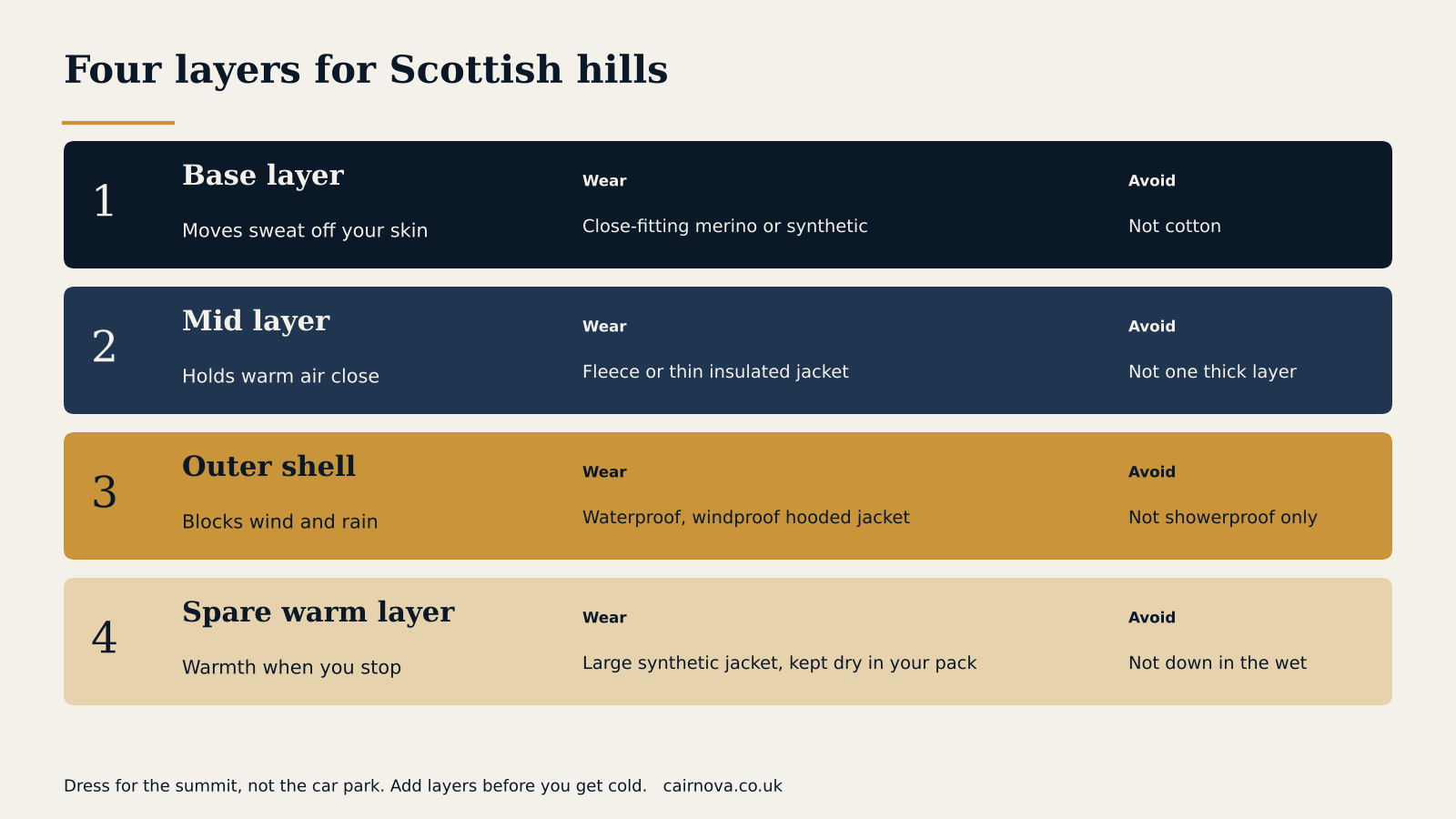
You will see this called the three layer rule. It is not a rule so much as a method: wear thin layers you can adjust, rather than one thick layer you are stuck with.
Why Scotland needs more than a jumper and a jacket
The Met Office says the air gets about 2°C colder for every 300 m you climb, although the rate varies. A 900 m summit can therefore be around 6°C colder than the glen. The same guidance says wind speed roughly doubles at 900 m compared with low ground, and it gives an example: a 40 mph wind at 3°C feels like -10°C on a wet or sweating body.
Mountain forecasts say this plainly. A Mountain Weather Information Service (MWIS) forecast for the West Highlands in November 2025 gave the effect of wind on you as “extensively difficult walking where exposed with powerful gusts and considerable wind chill”. That is a warning about what your clothes need to cope with, not just about the weather.
Heather Morning, then the mountain safety advisor for the Mountaineering Council of Scotland (now Mountaineering Scotland), said that cotton “provides no insulation and will quickly cool the skin” once it is wet from rain, snow melt or sweat. She also called it a common misconception that modern clothing is so good that hypothermia is not an issue. The risk factors she listed include sweating on the ascent and then not adding layers, poor food and drink, fatigue and not enough windproofing. Her advice is to add a layer as you climb, change into dry gloves, carry a large synthetic jacket for stops and descents, and eat enough, because clothing keeps heat in rather than making it.
Stopping is where most people get caught. You can start to cool within minutes of standing still. RAF Lossiemouth Mountain Rescue advises carrying spare gloves, hats and base and mid layers, because sweat, snow or rain will probably soak what you are wearing, and it reports gusts on the Cairngorm plateau above 70 mph in its worst conditions.
Base, mid and outer layers
Base layer
This sits against your skin, fits close without being tight, and moves sweat away so you do not chill when you slow down. Synthetic fabrics wick well and suit summer. Merino wool is warmer, comfortable and naturally resists odour, and blends of the two cost more but combine both. Cotton absorbs sweat and holds it. Choose a lighter base layer for summer and a heavier one for winter.
Mid layer
The mid layer does most of the insulating by trapping warm air. Fleece is the usual choice, because it breathes and keeps insulating when damp. In mild weather it can stay in your pack as a spare. When it is cold, a thin insulated jacket or gilet works instead, and in very cold weather you can combine two. The Great Outdoors magazine, with advice from Mountaineering Scotland, recommends carrying several mid layers from thin to thick, so you can adjust as you climb and cool down.
A softshell sits between the mid layer and the shell. It is windproof, very breathable and handles light showers, which suits a reasonable forecast or a day when you will sweat a lot. It is not a replacement for a waterproof in heavy rain.
Outer shell
The shell is your protection from wind, rain and snow. The BMC lists the features worth looking for: a hood you can see out of, pockets you can reach with a rucksack on, and a map pocket. Over-trousers are worth carrying on long wet days, and the BMC advises side zips so you can pull them on over boots.
No shell breathes perfectly. A membrane can struggle when you sweat harder than it can move moisture, which leaves you clammy, and vents such as pit zips help. See the waterproof ratings section below for what the numbers on a label mean.
The spare warm layer
This is the layer most people leave at home. You do not wear it while you are working hard. You put it on when you stop for lunch, wait for a friend, or stand on a cold summit, and again for the descent.
Choose synthetic insulation over down for Scottish conditions. The BMC notes that synthetic insulation can be worn on the move, dries quickly and keeps insulating when wet, while down loses insulation when wet. Alpkit and The Great Outdoors both make the same point for Scotland’s damp hills. Down is fine on a dry, cold day if you are sure you can keep it dry.
Legs, feet, head and hands
Trousers and over-trousers
Wear lightweight, quick-drying walking trousers made of nylon, polyester or wool blends. These fabrics move moisture away and dry fast. Carry waterproof over-trousers in your pack. In cold weather some walkers add thermal leggings under their trousers, and others only need winter-weight softshell trousers. Jeans are the one thing to leave at home, and the FAQ below explains why.
Socks and boots
Wear wool or synthetic socks with extra padding at the toes and heels, and never cotton. For footwear, the advice from walking and guiding organisations is boots with ankle support and good grip. Rough, wet ground is normal on Scottish hills, even on popular paths. Gaiters are optional, and they help keep water out on wet days. Winter boots with stiff soles are a separate topic, and belong in a winter guide.
Hat, gloves and buff
A hat matters because you lose heat through your head, and a thin one for the climb and a warmer one for the top lets you adjust. Gloves matter more than most people expect, because cold hands make a day miserable fast. Carry a spare pair, and change into the dry pair when the first ones get damp. A buff or neck gaiter is light, covers your neck, and the BMC recommends one on cold days.
What to wear by season
| Season | What changes | Watch for |
|---|---|---|
| Autumn | Swap the thin summer hat, gloves and emergency jacket for warmer ones. Put a head torch with fresh batteries in your pack. Start earlier. | Shorter days and the first cold, wet weather |
| Winter | Add a second mid layer, several hats and spare gloves, and a large synthetic jacket for stops. Cover exposed skin in strong wind. | Wind chill, short daylight, snow and ice, which need winter skills and equipment |
| Spring | Winter-weight hat and gloves stay in the pack. Layers matter more than temperature. | Snow and ice on high ground, which can last into May |
| Summer | Lighter base and mid layers, a sun hat and sun cream. Still carry a shell, a warm layer, a hat and gloves. | Midges, which are worst from late July to August |
The autumn advice comes from Mountaineering Scotland, which tells walkers to upgrade hats and gloves, take a more substantial emergency jacket and start earlier as the days shorten. Spring conditions vary a lot by year, so use the forecast and not the calendar.
Summer brings midges. Walkhighlands says the season runs from early June to early September and peaks from late July to August, and that a head net is “absolutely essential”. Keep your arms and legs covered when you stop, and wear a brimmed cap so the net sits away from your face.
Want all of this on one page? Download our printable hillwalking kit checklist (PDF) and keep it with your rucksack.
Read the forecast, then choose your layers
The best clothing decision you can make is the one before you leave the house. A mountain forecast tells you what the summit will be like, and MWIS publishes one for each upland area with rows that map straight onto your kit. These are Cairnova’s suggestions for acting on them, not official thresholds.
| MWIS row | What it tells you | What to do |
|---|---|---|
| How windy? (on the Munros) | Wind speed at summit height | Strong wind is why you need a windproof shell, and why stopping on a summit is cold. |
| Effect of wind on you? | A plain-English description of what wind will feel like | If it warns of difficult walking or considerable wind chill, take the full kit and plan a shorter or lower day. |
| How cold? (at 900 m) | The temperature at 900 m, including wind chill | If it is near or below freezing, pack the warm hat, spare gloves and your big spare layer. |
| Freezing level | The height where the air reaches 0°C | If it is below the tops you will walk into ice or snow, and need to dress for it. |
| Cloud on the hills? | How high the cloud base is | In cloud everything is damp and colder, so put your shell on early. |
MWIS says forecasts are issued daily by 16:30 and can change, so check again in the morning. Our Munro guides, such as the Ben Nevis guide, include a 7-day and hourly forecast, live conditions and a hazard assessment, and Mountain Intelligence has an interactive 3D map for each route. Look at the summit forecast first, then pack.
What not to wear
- Cotton: T-shirts, hoodies, cotton socks and cotton base layers. They absorb sweat and rain, lose their insulation and cool your skin.
- Jeans: heavy when wet, slow to dry and restrictive. The BMC advises avoiding them.
- Trainers and flimsy shoes: they offer little grip or ankle support on wet, rough ground. Guiding and walking organisations recommend proper walking boots.
- Down in wet weather: it loses its warmth when damp. Choose synthetic for the spare layer.
- One thick layer: you cannot adjust it. Several thin layers insulate better and are easier to manage.
- Clothes that are too tight: trapped air is what keeps you warm, so leave a little room between layers.
Waterproof ratings explained
Labels on waterproof jackets quote a hydrostatic head figure in millimetres. This is the height of a column of water the fabric can hold before it leaks, and a higher number means more waterproof. Retailers give broad bands, and they vary a little between brands. This is a rough guide:
| Hydrostatic head | What it roughly means |
|---|---|
| Below 3,000 mm | Not considered waterproof |
| Up to 5,000 mm | Light showers and drizzle only |
| About 10,000 mm | Entry level, fine for dry or mildly damp days |
| About 15,000 mm | Reliable in rain, snow and wet conditions |
| 20,000 mm and above | Premium, and usually heavier and bulkier |
Breathability matters as much as waterproofing on a long climb. It is quoted as MVTR, where higher is better, and 10,000 to 15,000 g/m² is described as good for hiking. It is also quoted as RET, where lower is better: 0 to 6 is excellent, 7 to 13 is good, 14 to 20 is acceptable and above 20 is poor.
These are laboratory figures, and they do not guarantee how a jacket performs in a Scottish downpour. Seams, the hood, ventilation and fit all matter, and the water-repellent coating wears off over time, so re-proof it. A very waterproof jacket that does not breathe will leave you wet from sweat instead.
Frequently asked questions
What should I wear hill walking in Scotland?
Wear a close-fitting wicking base layer, a fleece or synthetic mid layer and walking trousers, with boots and wool or synthetic socks. Carry a waterproof, windproof shell with a hood, waterproof over-trousers, a spare warm layer, a hat and gloves. Adjust the weight of each layer for the season and the summit forecast.
What is the 3 layer rule for hiking?
It is the base, mid and outer layer system: a wicking base layer, an insulating mid layer and a waterproof, windproof shell. You add or remove layers to stay comfortable. On Scottish hills, also carry a spare warm layer to put on when you stop, because you cool quickly when you are not moving.
Are jeans okay for hiking?
No. Jeans are cotton, so they absorb rain and sweat, dry slowly, get heavy and restrict your movement. Wet cotton gives no insulation and cools your skin. The BMC advises avoiding jeans for hill walking. Choose quick-drying walking trousers made of nylon, polyester or wool blends instead.
What kind of trousers are best for hiking in Scotland?
Lightweight, quick-drying walking trousers that do not hold water, plus waterproof over-trousers in your pack. Over-trousers with side zips can go on over boots. In cold weather, add thermal leggings underneath or choose winter-weight softshell trousers. Avoid jeans, cotton and anything that restricts your stride.
What should you not wear hill walking?
Avoid cotton clothing, jeans, trainers and any single thick layer you cannot adjust. Do not rely on down when it is wet, and do not wear clothes so tight that they squash the air that keeps you warm. Leave the cotton socks at home too, because wet feet blister and chill.
What should a woman wear hillwalking?
The same system applies to everyone: a base layer, a mid layer, a shell and a spare warm layer. The difference is fit. Clothes that fit badly let in cold air or restrict your movement, so try your layers together before a big day and leave a little room between them. This guide does not recommend brands or specific products.
Do I need waterproof trousers?
Carry them. They are light, they pack small, and long wet days are common on Scottish hills. The BMC recommends waterproof over-trousers for long wet walks, ideally with side zips so you can pull them on over boots. In a dry forecast you may not wear them, but they are cheap insurance.
Is down or synthetic better in Scotland?
Synthetic is the safer default for Scotland. It keeps insulating when it is wet, dries quickly and can be worn on the move. Down loses its insulation when damp and suits cold, dry days when you can keep it dry. Heather Morning recommended a large synthetic jacket for stops and descents.
What should I wear in midge season?
Carry a head net and wear a brimmed cap so the net sits away from your face. Keep your arms and legs covered when you stop, because midges bite when you are still. Walkhighlands says the season runs from early June to early September, with the worst from late July to August.
Can I wear shorts hillwalking in Scotland?
You can in warm, settled summer weather, and some guiding companies list shorts as optional for summer. Still carry waterproof over-trousers and a warm layer, because the summit will be colder than the glen. Shorts are a poor choice in midge season and from autumn to spring.
How we checked these numbers
The layer descriptions come from the BMC guide to hill walking clothing and layers, its what to wear and what to take page and Mountain Trails’ layering guide. The temperature and wind figures come from a Met Office guest post on the GO Outdoors blog, which is undated, so treat them as general guidance. The effect-of-wind example and forecast structure come from an MWIS West Highlands forecast. The cotton and hypothermia advice comes from Walkhighlands and Grough, quoting Heather Morning. The spare clothing advice and the wind speed figure come from RAF Lossiemouth Mountain Rescue. Winter layering and the synthetic versus down point come from The Great Outdoors and Alpkit, and we use these retailer pages only for general advice. Autumn advice comes from Mountaineering Scotland, and the midge advice from Walkhighlands. Waterproof rating bands come from the Kathmandu and inov-8 guides, which are retailers, so treat the bands as a rough guide. The jeans advice also draws on Advnture. Sources differ in emphasis, and we say where. Last checked October 2026.
Planning a day out? Check the summit forecast and safety information for your hill on Cairnova Mountain Intelligence, then pack to match. If you are new to the hills, start with our guide to the easiest Munros for beginners, and read how to prepare for climbing Ben Nevis before you plan it.
